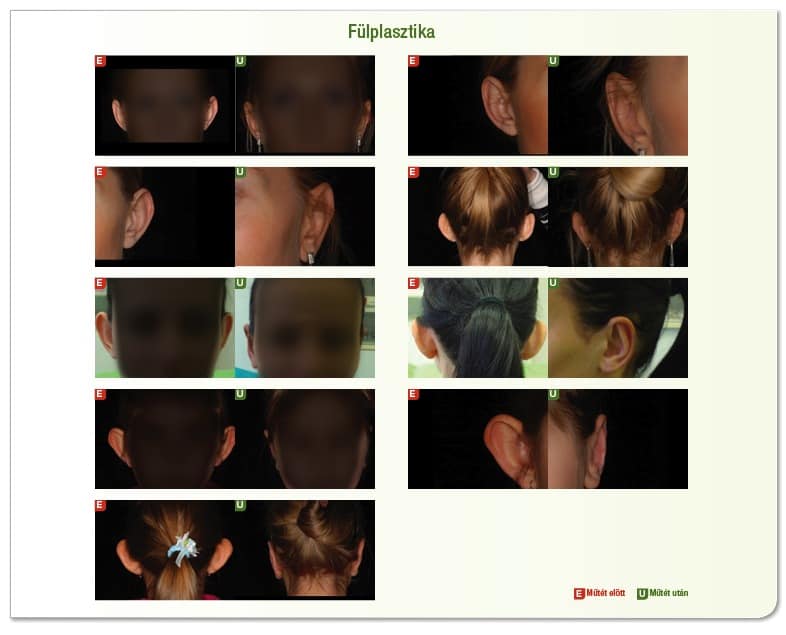

Earplastics
The ear plays a significant role in creating the aesthetic unity of the face. This harmony can be significantly disturbed by differences in the ear, both in form and size. Corrective surgery is mainly used to treat congenital anomalies, the main groups of which can be:
differences in size
formal derogations: the relationship between the parts is changed.
difference between skull and ear
A broken aesthetic unit can often cause an explicit psychic problem, mainly in children, as an integration problem, especially in the area of starting school, changing school, or the need for a change in friendship may lead to the idea of a corrective surgery.
The correction of the most common so-called retiring ear-muff, together with the formal differences of the ear-muff cartilage (breeding ears, fly crowns, cat ears, etc.), can be corrected with good surgical results. The procedure may be performed under local anaesthesia without any particular pain. The surgery time for correcting both ears should normally not exceed 60 minutes.
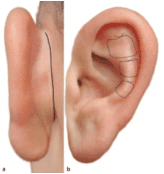
During the operation, the cartilage corresponding to the difference in size is removed from the posterior part of the mussel on the basis of the posterior part of the pruning fold behind the ear, together with the skin part. It is often necessary to prune on the front surface of the ear, which remains almost invisible after healing. After surgery, the ear is modelled to record the shape of the ear. The head is tied to a turban. The modelling and sutures are removed after one week. Fixation stitches are taken over 9 days. The operable ear should be protected for 3 to 6 weeks, for which it is recommended to wear a headband. Optimally, no visible scar remains and hearing is not affected by the operation. Surgery can be performed at any age, but is mainly recommended after 6 years of illness. It is advisable to wait for the age at which the child wants the operation and is able to co-operate on the operating table.