
Eye-shell plastic
blepharoplastica
Unfortunately, with the passage of time, signs of ageing are becoming more pronounced. Hitherto young gaze becomes tired, the area of the lower eyelids becomes ‘bag’, and it is often increasingly difficult to open the eyes, especially at the end of a tiring day when a very pronounced excess of skin hits the eyelid. Collagen becomes overt and wrinkled as a sign of degeneration and as a result of subcutaneous depletion. Ocular plastic surgery eyelids it consists of the excision of excess skin and, if necessary, the resection of the elongated muscle of the eyelid, and the removal of excess fat. This increases the firmness of the remaining skin.
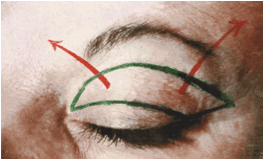
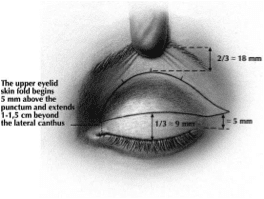
Eyelid plastic remove the skin and, if necessary, wrinkle excess fat from the upper eyelid during the course of the procedure. The excess skin is pre-marked and the pruning is dropped in the shearing fold, leaving the scar well hidden and almost invisible after healing. During surgery, if excess fat is detected, it is removed by opening the compartment, septum. After the restoration of the ovoid loose muscle, the area is stratified after careful haemostasis. The skin is closed by a non-absorbable pruning weld with a prolen of 6/0.
Lower eyelid plastic similar to upper eyelid plasticics, excess skin and fat are removed during surgery. Pruning is conducted 1-2 mm from the skeleton to the edge of the orbital canthus and ends 2 mm downstream of the lateral canthus in a raised wrinkle. During the operation, the skin is prepared and any excess fat removed after incision of the orbital septa throughout its length. Close the wound with a suture that cannot be absorbed after haemostasis.
Surgery is carried out in local anaesthesia, Epinephrines 2%—we use Lidocain. The intervention is not accompanied by significant pain, only the starter puncture can present some inconvenience.
The wound is bonded and covered over its entire width with a special, sterile, paper-like wound pass. No other knitting shall be used.
After surgery, the few secretions in the eyegrowth can be removed by careful camomile cleaning. The use of eye drops may reduce lacrimation. It is recommended to use antibiotic eye drops (Tobrex 5×1 drops) or ointments (Floxal 3x per day).
Welds are removed after 5-7 days. The eyes and faces can then be bathed.
Eyelid or eyelash dyeing is forbidden for 3 weeks! Skin care and make-up of the face is free after surgery.
It is recommended to wear dark spectacles under bright light for a few days after surgery.
Tissues around the eye are among the loosest tissues in the body, so that after surgery the eyelids swell and become blue-coloured (blooded) with pink blood-sprayed secretions leaked during the first 48 hours. The patient may feel tension and have difficulties in opening and closing his eyelids, especially in the morning, often with ease. Due to swelling, the closure of the eyes may be temporarily imperfect or, in the case of the lower eyelids, they may be temporarily slightly ruptured.
These symptoms can be significantly reduced by heating the surgical area, which is absolutely necessary for the first 2 days.
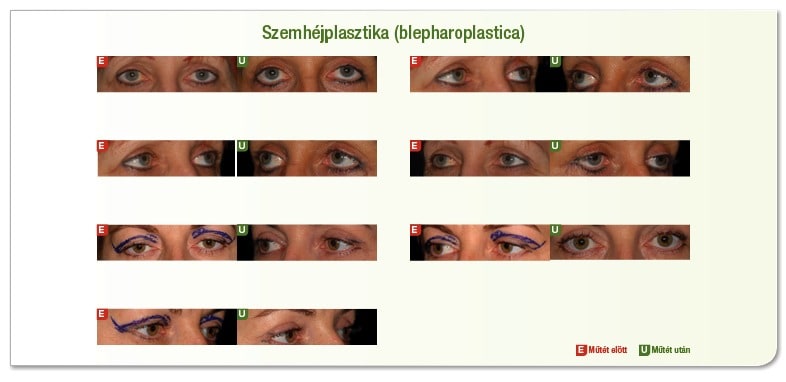
Surgical scars are barely visible 1-2 weeks after surgery and practically invisible after 2-3 months. The final aesthetic result will be complete in 2-3 months.
The durability of surgery can be affected by many factors. Experience has shown that it may take between 8 and 10 years for the operation to be repeated.