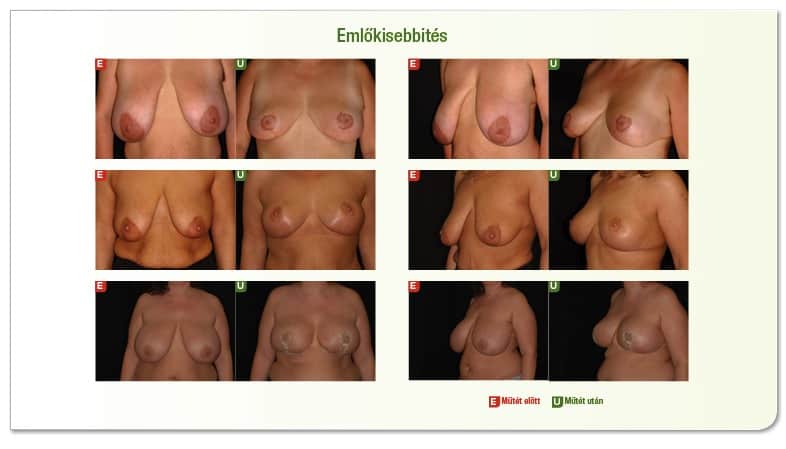

Reductio mammae
Mammary enlargement (hypertrophia) is an enlargement of the mammary gland, which over time leads to distortion of the mammary form by elongation of the skin and suspensions. The most common complaints are poor maintenance, back pain due to increased dorsal curvature of the spine, breathing problems, tightening of the brassière strap, pain around menstruation in the breasts, flexion folds inflammation of the skin and psychic problems. The most common form of lesion is puberty, less often after childbirth. Its conservative treatment is unknown, but wearing a brassière may reduce complaints.
The procedure (artificial surgery) can only be carried out in fully adult breasts from the age of 16. The remaining breast stock may put into question breast-feeding.
Surgery can only be carried out on a patient with a good general condition, after an appropriate preliminary investigation. An important consideration is the choice of the time of surgery: intervention is not recommended during the period of menstruation.
Surgery is performed in intubation narcosis (underlay). It consists of reducing the gland population to the desired size, together with the removal of excess skin, and then raising the nipple to the correct height. In the meantime, a reduction of the boot yard may be carried out, if necessary, on the basis of a prior discussion. The incisions are closed with non-visible pruning welds in the subcutaneous tissue and in the skin, which are removed at a later stage.
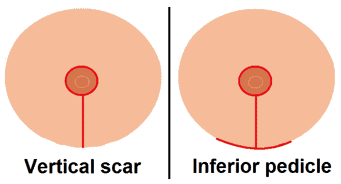
Depending on the technique used, location of the scars:
At the end of the operation, the breasts are fastened by an external blasting agent to prevent welds being stretched by their weight to ensure ideal wound healing and optimal scarring.
Surgery lasts between 2.5 and 3 hours, depending on the breast size. Stay in hospital 1-3 days. Welds are then removed in two parts in 2-3 weeks. After welding, it is recommended to treat the scars using an ointment, a silicone plaster, using a laser to achieve as thin and aesthetically impeccable scars as possible. The wearing of a brassière is necessary for weeks to clear the suture row, at least 4 weeks a day and night, and later 2 weeks, depending on wound healing, to avoid sunbeds and sunbeds to avoid hyperpigmentation of the scars. Appropriate physical care is not recommended for a period of 6 weeks.